

Published: By Trucell4 min read
What does a computer consultant actually do, and when should a business hire one?
What a computer consultant does, how they differ from managed IT support, what engagements typically involve, and when a Sydney business should hire one.
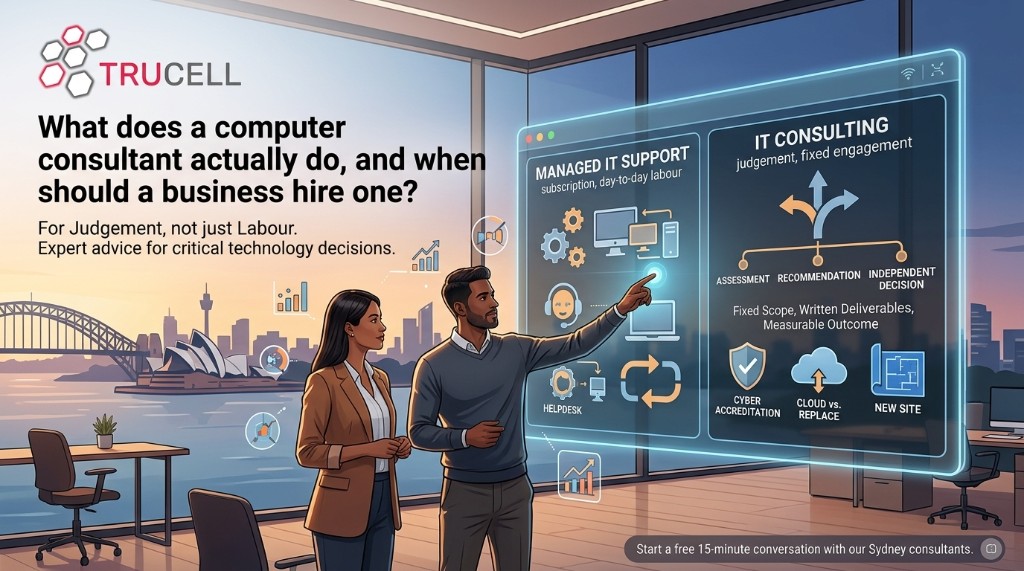
Search for “computer consultant” and you will find two very different things wearing the same name: career guides explaining the job title, and IT companies hoping you meant “IT support”. Neither answers the question a business owner is actually asking, which is usually some version of: I have a technology decision or a technology mess, and I want someone qualified to tell me what to do about it. Who is that person, and what do they actually do?
This guide answers that question properly, including the honest parts about when you do not need one.
The short answer
A computer consultant is engaged for judgement, not labour. You bring them a decision or a problem: replace the server or move to the cloud, why does everything feel slow and fragile, what would a security-conscious insurer want from us, how should IT work across our three sites. They assess what you actually have, weigh the options against your budget and risk, and give you a recommendation with reasons, in writing, that you can act on.
That is different from IT support, which keeps what you already have running day to day. Support is a subscription; consulting is an engagement with a deliverable. Plenty of businesses need both, but they are bought differently and judged differently.
What a good engagement actually looks like
A real consulting engagement has a shape. If what you are being offered has no shape, you are probably being sold something else.
- Assessment. The consultant looks at what you actually run: systems, licences, contracts, backups, security posture, and the costs attached to each. Not a questionnaire; an actual look.
- Recommendation. A written, sequenced recommendation with costs and trade-offs stated plainly. You should be able to hand it to your accountant or your board and have it make sense.
- A decision that stays yours. The document is yours to keep and act on with anyone, including a provider that is not the consultant. Any consultant who bristles at that has told you something important.
- Optional implementation. If you want the recommendation delivered, the consultant either does it accountably or hands over cleanly. Either is fine; vagueness about which is not.
When you actually need one
The pattern that calls for a consultant is a decision with real money or real risk attached, plus conflicting or missing advice:
- An ageing server and no costed plan: cloud, replace, or stretch another year.
- A Microsoft 365 environment that grew organically and now nobody is sure what is safe to change.
- A cyber insurance or accreditation questionnaire that needs honest answers, not guesses.
- An office move, fit out, or new site where the cabling and network decisions get poured into concrete.
- Vendors giving you confident, mutually exclusive quotes.
And the honest counter-list: you probably do not need a consultant for a single broken thing (that is a support call), for a decision already made that just needs doing (that is a project), or if your annual IT spend is small enough that any recommendation would cost more than it saves. A decent consultant will tell you this on the first call.
The question to ask any consultant: how do you earn?
Every consultant has an economic angle, and the trustworthy ones state it plainly. Some earn only from advice, which keeps the advice pure but leaves nobody accountable for whether it works in practice. Some earn from the products they recommend, which you should factor into every recommendation they make. Some, like us, also build and operate what they recommend: which means the advice is written by people who will have to live with it, and you should still ask the question and hear a straight answer.
Whatever the model, verify the checkable claims before you engage anyone: certification claims should come with a standard and a certificate number you can look up on the JAS-ANZ register, trading history should be checkable against the ABN on the Australian Business Register, and reviews should carry real names on a public listing. Titles are free; those three checks are not fakeable in five minutes.
What it costs
Honest answer: it depends on scope, which is why we do not publish a rate card for consulting and are suspicious of anyone who quotes before assessing. What you can and should insist on is a fixed, written scope before work starts: what is being assessed, what you receive, and what it costs, so a consulting engagement never becomes an open-ended bill. Small decisions deserve small engagements; a fifteen minute conversation is often enough to size it.
If you are weighing a decision now, our computer consultants in Sydney take exactly that conversation for free, and part of the job is telling you when you do not need us.